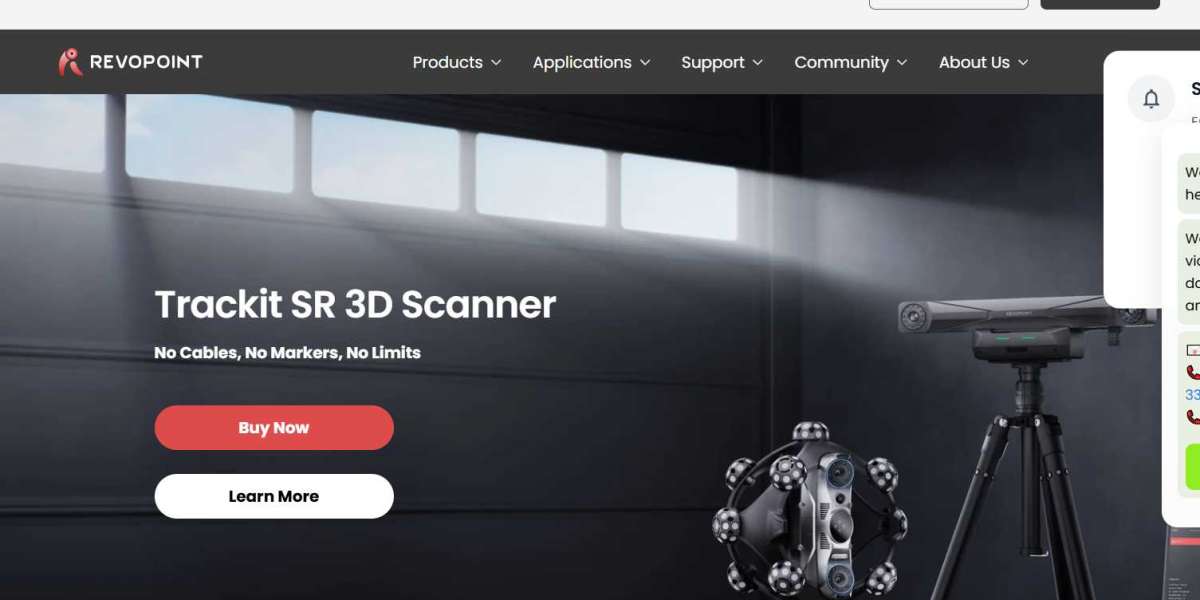

3D printing has become an important technology for manufacturers, engineers, designers, and creative professionals who want to turn digital ideas into physical products. However, creating precision 3d scanneraccurate digital model can sometimes be challenging, especially when working with an existing object. Revopoint 3D scanners help address this challenge by capturing the shape and surface details of physical items and converting them into digital data suitable for further design work. This process makes 3D scanning a practical solution for anyone interested in improving product development and reverse engineering.
One of the most useful features of 3D scanning is the ability to reproduce an object's geometry without measuring every dimension manually. Traditional modeling requires users to take measurements, draw technical sketches, and construct a digital model step by step. While this method remains valuable for many engineering applications, it can become time-consuming when an object contains complex curves, irregular surfaces, or intricate details. A suitable Revopoint 3D scanner can capture these features and provide a starting point for digital reconstruction.
The process generally begins with preparing the object and selecting the appropriate scanning method. Users should consider the object's size, surface material, and required level of detail before starting. Depending on the scanner model, tracking technology, lighting conditions, and scanning settings may also influence the results. Once scanning is complete, the captured data can be processed with compatible software to generate a three-dimensional model.
After processing, the digital model can be used in a 3D printing workflow. Users may need to repair holes, remove unwanted data, adjust the geometry, and ensure that the model forms a suitable closed surface before exporting it to slicing software. The slicing program then converts the model into instructions that a compatible 3D printer can follow. This workflow can be particularly useful when reproducing decorative objects, creating customized accessories, or developing prototypes based on existing physical designs.
Reverse engineering introduces additional possibilities for professional users. When a replacement component is unavailable or an original design file has been lost, scanning can help capture the external shape of the existing part. Engineers can use this information to reconstruct the component in computer-aided design software. They can also modify the design to improve functionality, accommodate different materials, or adapt the part to a new application.
It is important to understand that a scan does not automatically produce a perfect engineering model. Fine internal features, hidden surfaces, and precise functional dimensions may require additional measurements or specialized inspection methods. For components that must fit together accurately, engineers should verify critical dimensions rather than relying exclusively on the scanned mesh.
Revopoint 3D scanning solutions can also benefit education, artistic production, and small businesses. Students can explore digital manufacturing, artists can preserve physical creations, and entrepreneurs can experiment with new product concepts. By reducing some of the manual work involved in digitizing objects, scanning technology can make design experimentation more accessible.
Choosing the right scanner requires careful consideration of accuracy specifications, scanning volume, software compatibility, portability, and the types of objects being captured. Users should compare individual models to identify the most appropriate solution for their projects.
Ultimately, Revopoint 3D scanners can help bridge the gap between physical objects and digital manufacturing. When combined with suitable modeling software, careful scanning techniques, and proper quality checks, they provide a useful foundation for 3D printing, reverse engineering, and innovative product design.


